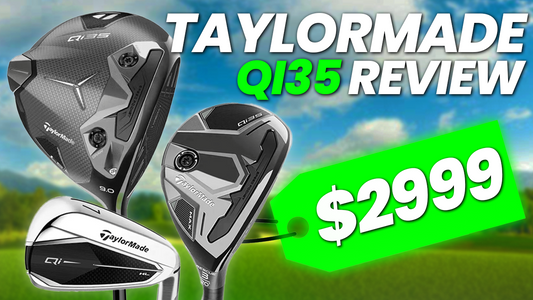

TaylorMade fairway woods have been some of the most popular woods on the market for years, and with the new Qi4D lineup, they’re promising even more speed, forgiveness, and adjustability.
So naturally, the Bogey Book boys had to take a closer look and find out if they actually perform better, or is this just another flashy release?
Let’s dive in and find out.
Key Takeaways
If you don’t have time to read the full blog post, here are the main things you should know about the TaylorMade Qi4D fairway woods.
- The Qi4D Core: balanced option with good distance, low spin, and solid forgiveness
- The Qi4D Tour: for better players, with adjustable weights for more control and accuracy
- The Qi4D Max: highest launch, softest landing, and most forgiving head
- Good ball speed even on off-center hits, especially low or toward the heel
- Each model suits a different golfer, so fit matters more than choosing the “best”

Are the TaylorMade Qi4D Fairway Woods Worth the Hype? (Honest Review)
First Impressions
Right away, the Qi4D fairway woods look seriously good.
TaylorMade has played around with a few different crown designs over the past couple of years, but this lineup looks much cleaner. The darker crown with that subtle orange tint gives it a premium look without being too flashy.
At address, the heads also separate themselves nicely.
From a looks standpoint alone, this is one of TaylorMade’s best fairway wood lineups in a while.

What’s New in the Qi4D Fairway Woods?
TaylorMade didn’t reinvent everything here, but they did refine a lot.
The Qi4D fairway woods still use familiar TaylorMade tech like Twist Face and the Speed Pocket, which helps preserve speed on low-face strikes.
The biggest talking point is in the head lineup and fitting options, following a similar multi-head approach we saw in the TaylorMade Qi4D drivers.
The Tour model features adjustable sole weighting to fine-tune forgiveness, bias, and strike performance. The lineup also offers multiple lofts, including 5-, 7-, and 9-woods, reflecting the growing demand for higher-lofted options.
TaylorMade also introduced new stock shaft options through Mitsubishi’s React system, which is designed around how the shaft rotates during the swing rather than just pure swing speed.

Qi4D Core Model
The Qi4D Core is the standard head, and for most golfers, this is probably where the fitting process will start.
It sits really well behind the ball, looks slightly open, and gives a nice blend of confidence and workability. In testing, the biggest standout was just how fast it was.
Qi4D Core Performance
- Ball speed: consistently around 155–161 mph
- Carry distance: regularly over 250 yards
- Spin: generally low, often between 2600–3500 rpm
- Main takeaway: very fast, with impressive forgiveness on misses
Even when the strike drifted low on the face or toward the heel, ball speed barely dropped off. That was one of the most impressive parts of the entire session.
For a fairway wood, that matters a lot. Most golfers do not strike 3-woods perfectly every time, so seeing a head keep carry distance and ball speed this well on mishits is a big deal.
The only slight concern was that spin occasionally got very low, which could make stopping power into greens a bit trickier for some players.

Qi4D Tour Model
The Tour head is the better-player option, but interestingly, it wasn’t dramatically lower spin than the Core model in testing.
What makes it special is the adjustability.
The sole weighting gives fitters far more control over how the head performs. During testing, moving the heavy weight into the heel helped improve ball speed on heel strikes and also tightened up the shot shape.
Qi4D Tour Performance
- Ball speed: just as fast as the Core model
- Spin: very similar to the Core, sometimes even slightly higher
- Adjustability: the key advantage of this head
- Main takeaway: ideal for better players who need dispersion tuning
That makes the Tour head really interesting.
It is not just a “low-spin bomber” head. It is more of a precision fitting option for players who want to move weight around, dial in strike location, and tighten directional control without sacrificing speed.
If you tend to miss consistently in one part of the face, this is the kind of head that can actually help a fitter build around that.

Qi4D Max Model
The Max was the most forgiving head of the bunch, and honestly, it wasn’t even close.
At address, it looks bigger, more stretched out, and slightly more closed. Better players might not love that look, but that’s not really who this club is built for.
Once the testing started, the Max immediately showed its purpose.
Qi4D Max Performance
- Launch: noticeably higher than the other models
- Height: significantly more peak height and stopping power
- Spin: slightly higher, which helps keep the ball in the air
- Main takeaway: the easiest model to launch and the most forgiving overall
Even poor strikes still launched high, carried well, and came down much softer. That is exactly what you want from a Max fairway wood.
For players who struggle to launch fairway woods off the deck, or for golfers looking at 5-, 7-, or 9-wood replacements for long irons, this head makes a lot of sense.
The dispersion was also the tightest of the three during testing, which says a lot considering the strikes were far from perfect.

Which Qi4D Fairway Wood Is Best for You?
This is where the lineup makes a lot of sense, because each head clearly serves a different golfer.
Who Should Play Each Head?
- Qi4D Core: the best fit for the widest range of golfers who want speed, lower spin, and balanced forgiveness
- Qi4D Tour: the better-player option for golfers who want adjustability and tighter dispersion control
- Qi4D Max: the best choice for golfers who need more launch, more peak height, and easier forgiveness
That is probably the biggest compliment we can give TaylorMade here.
The three heads do not feel like minor variations of the same club. They genuinely separate themselves in a meaningful way, which makes fitting much more valuable.
If you’re also considering a driver upgrade, the Qi4D driver lineup follows a similar
Find Your Fit
What’s your priority?
Pros & Cons
✅ Pros:
- Excellent ball speed across the lineup
- Very impressive speed retention on heel and low-face strikes
- Clear separation between Core, Tour, and Max heads
- Tour model offers genuinely useful adjustability
- Max head is extremely easy to launch and very forgiving
❌ Cons:
- Core model may spin a little too low for some golfers
- Tour head is less forgiving on poor misses than the Max
- Max head may look too closed or oversized for better players

Final Thoughts
The TaylorMade Qi4D fairway woods absolutely live up to the hype.
The biggest win here is not just raw performance, but how clearly each head fits a different player. The Core is a great all-rounder, the Tour gives fitters more tools to dial things in, and the Max is a proper forgiveness machine.
What impressed us most was the ball speed retention. Even poor strikes still held onto speed and distance much better than expected, which is exactly what most golfers need from a fairway wood.
So, are they worth the hype?
Yes - especially if you get properly fit into the right model.

★★★★☆ (8/10)
“The Max is ridiculously easy to hit, but the whole lineup makes sense. TaylorMade actually gave each head a real purpose.”
★★★★☆ (8.5/10)
“The Core and Tour were seriously impressive, especially on mishits. If you’re in the market for a fairway wood this year, these deserve a fitting.”
So would we put one in the bag ourselves? If the fitting numbers are right, absolutely. This is one of the strongest TaylorMade fairway wood releases in a while.